IKribati National Anthem for String Orchestra

US$8.99

The anthem was selected after a nationwide song competition to find a national anthem. Among those who participated in the competition were local composer and Protestant missionary Rev. Tom Toakai.

According to the National Identity Act 1989, the piece is to be sung at an andante tempo of 108.

See details

Marsallese National Anthem for Brass Quintet

US$8.99

"Forever Marshall Islands" (Marshallese: "Indeeo Ṃajeḷ"), also known by its incipit, "Aelōn̄ Eo Ao" ("Our Islands"), is the national anthem of the Marshall Islands. The lyrics were written by former President Amata Kabua, and the music was composed by Korean composer Gil ok-yun (also known by his Japanese name, Jun Yoshiya, 吉屋潤) by the request of President Kabua. The song was finished and recorded at Oasis Records in Seoul. Kabua and Gil became acquaintances after Jiyong (池勇), an economic adviser for President Amata Kabua, introduced Gil Ok Yun to Kabua.


See details

Micronesian National Anthem for String Orchestra

US$8.99

A bill to make "Patriots of Micronesia" the national anthem was introduced in 1987, and the anthem was adopted in 1991, replacing "Preamble", the state anthem in use since independence in 1979. The melody is that of the German student song "Ich hab' mich ergeben" with lyrics by Hans Ferdinand Massmann (also known as "Wir hatten gebauet ein stattliches Haus" with lyrics by August Daniel von Binzer), which was also one of the unofficial national anthems of West Germany between 1949 and 1952. The lyrics are also loosely based on a translation of "Ich hab' mich ergeben".

See details

Nauran National Anthem for String Orchestra

US$8.99

The anthem was composed by Anglo-Australian composer and military bandmaster Laurence Henry Hicks, who was leader of the Black Watch Band. It was adopted upon independence from the UN Trust Territory of Nauru, which was mostly administered by Australia, in January 1968. The anthem did not have official lyrics at the time, but lyrics by Nauruan composer Margaret Griffith Hendrie (1935–1990) were later adopted.

See details

New Zealand National Anthem for Brass Quintet

US$8.99

"God Defend New Zealand" (Māori: "Aotearoa",[a] meaning 'New Zealand') is one of two national anthems of New Zealand, the other being "God Save the King". Legally the two have equal status, but "God Defend New Zealand" is more commonly used. Originally written as a poem, it was set to music as part of a competition in 1876. Over the years its popularity increased, and it was eventually named the second national anthem in 1977. It has English and Māori lyrics, with slightly different meanings. Since the late 1990s, the usual practice when performed in public is to perform the first verse of the national anthem twice, first in Māori and then in English.

See details

New Zealand National Anthem for String Orchestra

US$8.99

"God Defend New Zealand" was written as a poem in the 1870s by Irish-born, Victorian-raised immigrant Thomas Bracken of Dunedin.

A competition to compose music for the poem was held in 1876 by The Saturday Advertiser and judged by three prominent Melbourne musicians, with a prize of ten guineas. The winner of the competition was the Vandemonian-born John Joseph Woods of Lawrence, Otago, who composed the melody in a single sitting the evening after finding out about the competition. The song was first performed at the Queen's Theatre, Princes Street in Dunedin, on Christmas Day, 1876. In February 1878, sheet music was published.

See details

Niuean National Anthem for Brass Quintet

US$6.99

The Niuean National Anthem arranged for Brass Quintet.

"Ko e Iki he Lagi" (English: The Lord in Heaven), also titled in English as "Lord in heaven, Thou art merciful", is the national anthem of Niue. It was adopted in 1974 when Niue became a self-governing state.

During Niue's history as a territory of New Zealand, the national anthem of Niue was New Zealand's "God Defend New Zealand". "God Save the Queen" was also used and is still used as the royal anthem for the Monarchy of New Zealand. "Ko e Iki he Lagi" was created before the 1970s. It is not known who wrote it but it is known that it was prepared by Sioeli Fusikata.[2][3] When it was written, it had become a popular song on Niue but the opportunity rarely arose for people to perform it publicly. In the 1963 South Pacific Games, Niue used the Flag of New Zealand as the flag to represent them in keeping with the rest of the colonies of the British Empire not using the Union Jack at the games. Niue also used "Ko e Iki he Lagi" as their anthem instead of "God Defend New Zealand" because the organisers had requested that "identifying tunes" be used to represent nations at the games instead of recognized national anthems. However, Niue failed to win any events so "Ko e Iki he Lagi" was not performed at the games.

In 1974, the same year that Niue's new constitution granted Niue the status of free association with New Zealand upon the passage of the Niue Constitution Act 1974 in the Parliament of New Zealand, Niue adopted "Ko e Iki he Lagi" as their national anthem to supersede "God Defend New Zealand". "God Save the Queen" was retained as the royal anthem for when the monarch is present in Niue.

See details

Niuean National Anthem for String Orchestra

US$6.99

An arrangement of the Niuean National Anthem for String Orchestra.

"Ko e Iki he Lagi" (English: The Lord in Heaven), also titled in English as "Lord in heaven, Thou art merciful", is the national anthem of Niue. It was adopted in 1974 when Niue became a self-governing state.

During Niue's history as a territory of New Zealand, the national anthem of Niue was New Zealand's "God Defend New Zealand". "God Save the Queen" was also used and is still used as the royal anthem for the Monarchy of New Zealand. "Ko e Iki he Lagi" was created before the 1970s. It is not known who wrote it but it is known that it was prepared by Sioeli Fusikata.[2][3] When it was written, it had become a popular song on Niue but the opportunity rarely arose for people to perform it publicly. In the 1963 South Pacific Games, Niue used the Flag of New Zealand as the flag to represent them in keeping with the rest of the colonies of the British Empire not using the Union Jack at the games. Niue also used "Ko e Iki he Lagi" as their anthem instead of "God Defend New Zealand" because the organisers had requested that "identifying tunes" be used to represent nations at the games instead of recognized national anthems. However, Niue failed to win any events so "Ko e Iki he Lagi" was not performed at the games.

In 1974, the same year that Niue's new constitution granted Niue the status of free association with New Zealand upon the passage of the Niue Constitution Act 1974 in the Parliament of New Zealand, Niue adopted "Ko e Iki he Lagi" as their national anthem to supersede "God Defend New Zealand". "God Save the Queen" was retained as the royal anthem for when the monarch is present in Niue.

See details

New Caledonian National & Local Anthems for Brass Quintet

US$8.99

"Soyons unis, devenons frères" ("Let us unite, let us become brothers") is the officially recognised anthem of New Caledonia. It was written by a group from the children's choir Mélodia in 2008 and officially adopted in 2010. It is not the national anthem of New Caledonia; as a special collectivity of France, the national anthem is the French national anthem, "La Marseillaise". During official ceremonies or sports events, "La Marseillaise" is performed first, followed by "Soyons unis, devenons frères"

See details

New Caledonian National & Local Anthems for String Orchhestra

US$8.99

"Soyons unis, devenons frères" ("Let us unite, let us become brothers") is the officially recognised anthem of New Caledonia. It was written by a group from the children's choir Mélodia in 2008 and officially adopted in 2010. It is not the national anthem of New Caledonia; as a special collectivity of France, the national anthem is the French national anthem, "La Marseillaise". During official ceremonies or sports events, "La Marseillaise" is performed first, followed by "Soyons unis, devenons frères"

See details

Palauan National Anthem for Brass Quintet

US$8.99

The anthem was composed by Ymesei Ezekiel (9 January 1921 – 20 May 1984), a composer, musician and music teacher, during the time of the transition from the Trust Territory of the Pacific Islands, which at the time was using the anthem of Micronesia, to the establishment of the Republic of Palau under the trust territory. A committee headed by member of the House of Delegates Demei Otobed was established to adopt a national anthem in line with the new constitution.

See details

Palauan National Anthem for String Orchestra

US$8.99

 Along with Otobed and Ezekiel, other members of the committee included historians and musicians Riosang Salvador, Kebekol Alfonso and Hermana Umetaro. The committee members collectively wrote the lyrics of the anthem. The anthem was officially adopted on 1 January 1981, when the Palauan constitution entered into force.

See details

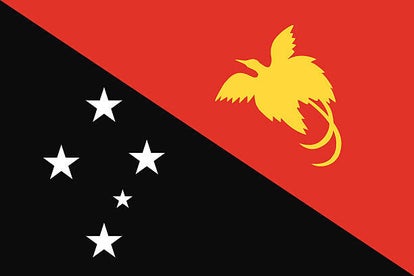
Papua New Guinea National Anthem for String Orchestra

US$8.99

The National Identity Act of Papua New Guinea was formulated in 1971, motivating the country to create a national flag, a national emblem, a national pledge and a national anthem. A national flag and emblem were adopted in 1971. However, the national anthem remained undecided until independence from Australia in 1975, four years later. Although many songs were submitted to be the anthem, the National Executive Council decided a week before the country's Independence Day (10 September 1975), to adopt as the national anthem a composition that was composed by Chief Inspector Thomas Shacklady (1917–2006), a bandmaster of the Royal Papua New Guinea Constabulary Band.

During the 2015 Pacific Games opening ceremony, the anthem was sung with the first line altered from "O arise all you sons of this land" to "O arise sons and daughters of this land". An official later stated that this was illegal and a violation of the National Identity Act.

See details

Samoan National Anthem for Brass Quintet

US$8.99

"The Banner of Freedom" (Samoan: "O Le Fuʻa o Le Saʻolotoga o Sāmoa"  known also as "Sāmoa Tulaʻi" - "Samoa, Arise") is the national anthem of Samoa. Both the words (which reference the country's flag) and the music were composed by Sauni Iiga Kuresa. The anthem was composed in response to a public competition to select a new anthem when the United Nations conferred self-government on Samoa in 1948 and was chosen from among 15 entries. It was performed publicly for the first time on 1 June 1948[and was subsequently played at all public ceremonies attended by the High Commissioner and performed after "God Save the Queen" on official occasions. It was retained as the national anthem upon Samoa's gaining of independence from New Zealand in 1962.

The anthem is recognised by the Official Flag and National Anthem of Samoa Act 1994. When it is sung or played in public, people and vehicles must stop and remain stationary until the performance is complete.

See details

Samoan National Anthem for String Orchestra

US$8.99

The anthem is recognised by the Official Flag and National Anthem of Samoa Act 1994. When it is sung or played in public, people and vehicles must stop and remain stationary until the performance is complete.

See details

Solomon Islands National Anthem for Brass Quintet

US$8.99

Solomon Islands national anthem was written in a form of prayer asking God for safekeeping and protection of our new nation. By the power and grace of God, we may receive joy, peace, progress and prosperity, if only we can be able to work together in harmony. These may be the foundation of building our nation, as we can be rest assured that we will reach our destination—stands forever more.

See details

Solomon Islands National Anthem for String Orchestra

US$8.99

Balekana claimed in interviews to have received his inspiration for the anthem in a dream. After he woke up from the dream, Balekana and his wife immediately began writing words and lyrics, as well as composing the tune. Panapasa and Matila Balekana co-wrote the lyrics for the anthem, while Panapasa composed the accompanying music. The couple credited prayer and God for their success in creating the anthem, noting how well the song came together.

See details

Tongan National Anthem for Brass Quintet

US$7.99

"Ko e fasi ʻo e tuʻi ʻo e ʻOtu Tonga" (pronounced [ko e fasi ʔo e tuʔi ʔo e ʔotu toŋa]; alternatively "Ko e fasi ʻo e kuini ʻo e ʻOtu Tonga" when the Tongan monarch is female) is the national anthem of Tonga. The title literally means "song of the king of the Tonga Islands" or "song of the queen of the Tonga Islands" (when the monarch is female) in the Tongan language but is in daily life better known as "Fasi fakafonua", which translates to "National Song".

See details

Tongan National Anthem for String Orchestra

US$7.99

"Ko e fasi ʻo e tuʻi ʻo e ʻOtu Tonga" (pronounced [ko e fasi ʔo e tuʔi ʔo e ʔotu toŋa]; alternatively "Ko e fasi ʻo e kuini ʻo e ʻOtu Tonga" when the Tongan monarch is female) is the national anthem of Tonga. The title literally means "song of the king of the Tonga Islands" or "song of the queen of the Tonga Islands" (when the monarch is female) in the Tongan language but is in daily life better known as "Fasi fakafonua", which translates to "National Song". 

See details

Tuvaluan National Anthem for Brass Quintet

US$7.99

Also the national motto, the title of the national anthem “Tuvalu mo te Atua” also appears on the nation’s coat of arms. The lyrics reflect the deep Christian faith of the song’s author and the nation as a whole. 

See details

Tuvaluan National Anthem for String Orchestra

US$7.99

Also the national motto, the title of the national anthem “Tuvalu mo te Atua” also appears on the nation’s coat of arms. The lyrics reflect the deep Christian faith of the song’s author and the nation as a whole. 

See details

Vanuatu National Anthem for Brass Quintet

US$7.99

Vanuatu gained its independence from both the United Kingdom and France in 1980. (I assume that during the colonial period, both anthems were used, however I do not know how they were performed). Upon independence, the anthem “Yumi, Yumi, Yumi”, written in the native Bislama language (a type of Pigdin English/French hybrid), was chosen as the national anthem.

See details

Vanuatuan (ni) National Anthem for String Orchestra

US$7.99

Vanuatu gained its independence from both the United Kingdom and France in 1980. (I assume that during the colonial period, both anthems were used, however I do not know how they were performed). Upon independence, the anthem “Yumi, Yumi, Yumi”, written in the native Bislama language (a type of Pigdin English/French hybrid), was chosen as the national anthem.

See details
  • Pacific hymn: Perhaps a subset of the “Western ode”, many countries in the Pacific have adopted as the music of their national anthem either a church hymn or folk song from a former (or current) colonial master, and applied new words to it for their national anthem. Examples include Bougainville, Fiji, Pitcairn Islands, and Micronesia.